

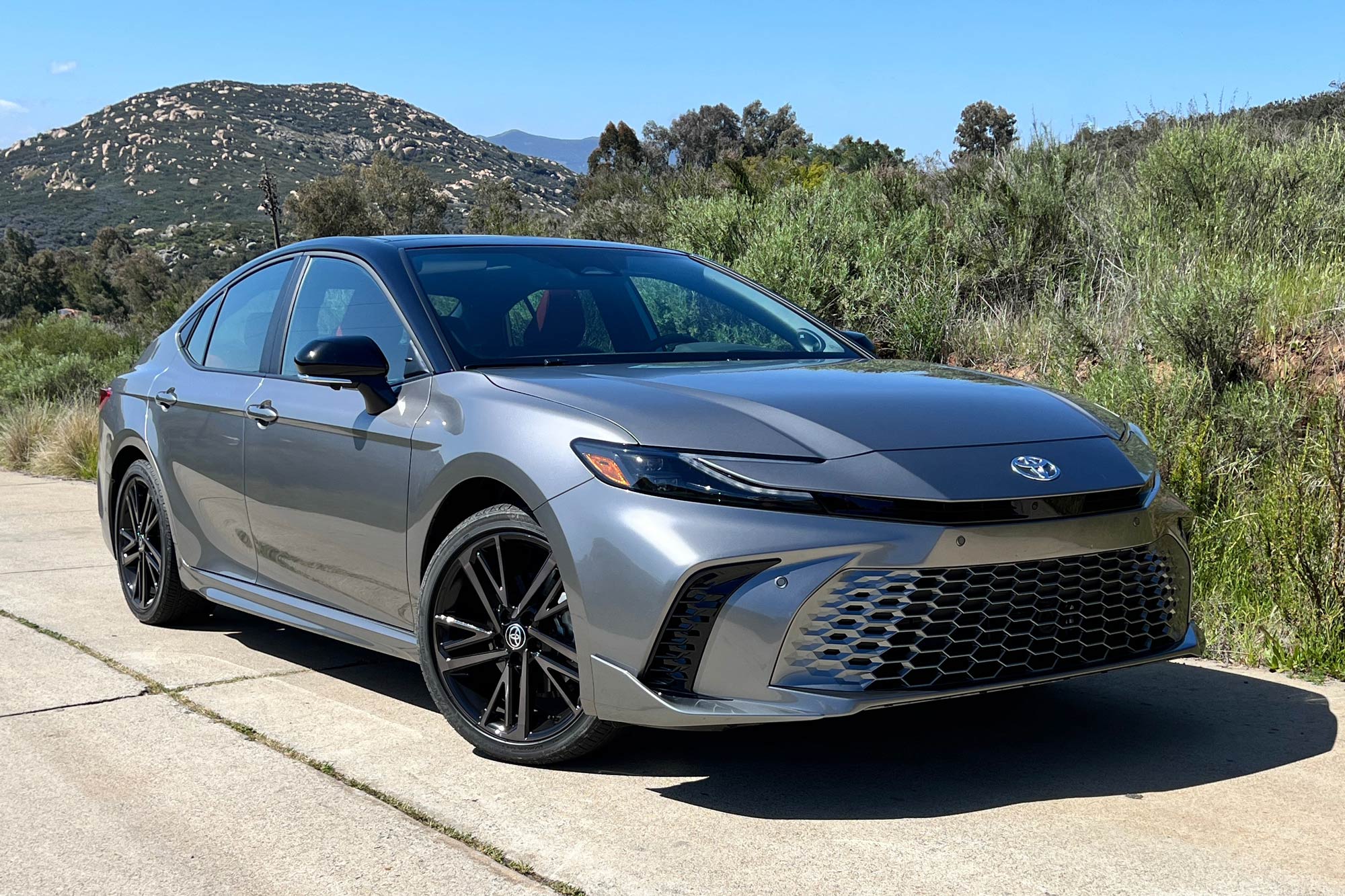
The 2025 Toyota Camry Hybrid represents the latest chapter in America’s best-selling sedan’s legendary story—now exclusively hybrid. By dropping the gas-only models, Toyota commits fully to hybridization, bringing superior fuel economy, refreshed styling, and modern tech. It’s an excellent choice for families, commuters, or anyone aiming to lower fuel costs while enjoying reliable performance.
This comprehensive review (updated as of January 2026) covers specifications, trims, driving experience, efficiency, safety, interior, pricing, and buying advice.
Key Specifications at a Glance
| Category | Details |
|---|---|
| Powertrain | 2.5L 4-cylinder + hybrid system: 225 hp (FWD) / 232 hp (AWD) |
| Transmission | Electronically controlled CVT (eCVT) |
| Drivetrain | Front-wheel drive standard; AWD optional |
| Fuel Economy (EPA) | LE FWD: 53 city / 50 hwy / 51 combined SE/XLE/XSE FWD: 48 / 47 / 47 AWD variants: Up to 44 / 43 / 44 (XSE) |
| 0–60 mph | ~7.0–7.8 seconds |
| Base Price (MSRP) | $28,700 (LE FWD) – ~$37,220 (XSE AWD, estimated) |
| Cargo Space | 15.1 cu ft trunk |
| Warranty | 3 yr/36,000 mi basic 8 yr/100,000 mi hybrid components 10 yr/150,000 mi hybrid battery |
What’s New for the 2025 Toyota Camry Hybrid?
The 2025 model is the second year of the ninth-generation redesign (introduced in 2024). Highlights include:
- Exclusive all-hybrid lineup
- Standard Toyota Safety Sense 3.0
- Faster infotainment system
- Optional 12.3-inch digital gauge cluster on higher trims
- Enhanced AWD torque distribution
- Minor exterior tweaks, including new colors and wheels
Trim Levels & Pricing (2025 MSRP, excluding ~$1,095 destination)
| Trim | Starting Price (FWD) | Starting Price (AWD) | Key Features |
|---|---|---|---|
| LE | $28,700 | ~$30,225 | Wireless Apple CarPlay/Android Auto, 17-inch wheels, dual-zone climate, 8-inch touchscreen, Toyota Safety Sense 3.0 |
| SE | ~$31,000 | ~$32,525 | Sport-tuned suspension, 18-inch black wheels, sport seats, leather-wrapped steering wheel |
| XLE | Higher | Higher | 12.3-inch screens, leather seats, heated fronts, ambient lighting |
| XSE | Higher | Higher | 19-inch wheels, aggressive styling, ventilated seats, premium audio option |
Prices exclude taxes, fees, and incentives—check dealers for current deals on remaining 2025 stock.
Performance & Driving Experience
The refined 2.5-liter inline-4 pairs with electric motors for smooth, responsive power: 225 hp (FWD) or 232 hp (AWD). Delivery is seamless with instant electric torque, and the eCVT stays quiet and refined.
Ride & Handling
- LE and XLE emphasize comfort with a serene, isolated ride.
- SE and XSE add sportier suspension for better control and less body roll.
- AWD provides extra grip in wet or snowy conditions with little efficiency loss.
Fuel Economy
The Camry Hybrid leads its class:
- Top rating: 53 city / 50 hwy / 51 combined mpg (LE FWD)
- Most trims: 48 / 47 / 47 mpg
- AWD XSE: 44 / 43 / 44 mpg
- Real-world: Often 48–53 mpg in mixed driving

Interior, Comfort & Technology
The modern cabin uses quality materials, excellent fit and finish, and ample space front and rear.
Highlights:
- Roomy seating and 15.1 cu ft trunk
- Standard wireless Apple CarPlay/Android Auto on 8-inch screen
- Optional dual 12.3-inch displays and JBL audio
- Superior sound insulation
- Available panoramic moonroof
Drawbacks:
- Thick pillars reduce rear visibility
- Base LE lacks rear vents
- Some controls are touchscreen-only
Safety Features
Standard Toyota Safety Sense 3.0 includes:
- Pre-collision with pedestrian/cyclist detection
- Lane departure alert with steering assist
- Full-speed adaptive cruise with lane centering
- Automatic high beams
- Road sign assist
- Proactive driving assist
Expected: IIHS Top Safety Pick+ and 5-star NHTSA.
2025 Toyota Camry Hybrid Pros and Cons
Pros
- Class-leading fuel economy
- Smooth, reliable hybrid system
- Spacious and comfortable interior
- Excellent resale value
- Full safety suite standard
- AWD option
- Legendary Toyota reliability
Cons
- No V6 or higher-performance variant
- Base trim feels basic
- Less athletic than some rivals (e.g., Accord Hybrid)
- Trunk space slightly reduced by battery
Competitors Comparison (2025 Models)
| Model | Combined MPG (Top) | Starting Price | Horsepower | Standout Feature |
|---|---|---|---|---|
| Toyota Camry Hybrid | Up to 51 (FWD) | ~$28,700 | 225–232 | Best efficiency, AWD option |
| Honda Accord Hybrid | Up to 48 | ~$33,000 | 204 | Sportier handling, spacious |
| Hyundai Sonata Hybrid | Up to 47 | ~$28,650 | 192 | Bold design, strong warranty |
| Toyota Prius | 57 | ~$28,000 | 196 | Ultimate efficiency, hatchback |
The Camry stands out for efficiency, reliability, and AWD availability.
Should You Buy the 2025 Toyota Camry Hybrid?
Yes, if you want:
- Top-tier fuel efficiency in a midsize sedan
- Available all-wheel drive
- Proven long-term reliability
- Quiet, comfortable daily driving
Alternatives if:
- Sharper handling → Honda Accord Hybrid
- Stylish design/warranty → Hyundai Sonata Hybrid
- Max efficiency/smaller size → Toyota Prius
Final Verdict
The 2025 Toyota Camry Hybrid continues its role as a benchmark midsize sedan—balanced, efficient, and dependable. With outstanding mpg, refined features, and great value, it’s a smart choice. In early 2026, look for incentives on leftover 2025 models. Test drive FWD and AWD to decide.
Driven one? Share your thoughts!